
ACADEMIC
State University of New York at Buffalo
New York Law School
George Washington University National Law Center
Syracuse University Whitman School of Management
University of Nebraska at Omaha
———————————

PROFESSIONAL
U.S. Department of Energy
U.S. Navy
National Aeronautics and Space Administration
Hanford Nuclear Site
Union Pacific Railroad Company
Santa Barbara Fantasy Football League
———————————
Major Environmental Laws
- Clean Air Act
- Clean Water Act
- Resource Conservation and Recovery Act
- Comprehensive Environmental Response, Compensation and Liability Act
- Safe Drinking Water Act
- Endangered Species Act
- National Environmental Policy Act
Environmental Law and Fantasy Football 🏈 🏈 🏈 BLOG
Welcome to the Environmental Law-Fantasy Football BLOG!! There are many lessons you can learn from this BLOG, communicated to you by an experienced environmental law specialist, and a dominant force in the fantasy football universe. 🏈
When I say “universe,” I mean all interstellar planetary locations where fantasy football may be relevant, including the all-pro Andromeda Galaxy, which is scheduled to merge with our own galaxy in 4.5 billion years.
Anyway, if you can embrace the lessons you will learn from this Blog, you may become the next BIG WINNER!
First Down—-> 🏈
So, which came first? Environmental Law or Fantasy Football? To answer this question, let’s step into the “Way Back” machine, and carbon-date them both!
The first environmental law enacted by the federal government was the “Rivers and Harbors Act of 1899.” It placed controls on the discharge of contaminants and other debris into the nation’s navigable waters. Why only navigable waters? Because “navigable waters” were used to support “interstate commerce,” and this link gave the federal government a legal basis to exercise its authority. If the waters were non-navigable, the individual states, not the federal government, would have jurisdiction.
Anyway, this was the first federal environmental law, and even though it was enacted almost 126 years ago, it DID NOT predate the game of football 🏈.
The very first game of football, which evolved from the games of rugby and soccer, was played on November 6, 1869 between Rutgers University and Princeton University. This was thirty (30) years before “Rivers and Harbors” made the scene, and 155 years before today. Who would have guessed that? Certainly not the guys in my fantasy football league!
By the way, if you think football is old, consider soccer ⚽️, which can trace its roots back 3,000 years to the ancient Mesoamerica region (consisting of present-day Mexico and most of Central America). Hold on! This gets better! The archaeological evidence suggests that soccer was played by the Aztec, Mayan, and Teotihuacan societies. In fact, archaeologists (like Indiana Jones) believe the Aztecs used it as a substitute for warfare, e.g., to gain ruling rights, and/or to resolve diplomatic disputes, while the Mayans purportedly subjected losers, and sometimes winners, to human sacrifice.
Can you imagine a game played in Mayan territory, where the winners are rewarded by taking their lives? Consider the following exchange between Mesoamerican play-by-play announcers, Costa Rico and Panama Pete: 🎙️
- Costa Rico: Well, Pete, we’re here tonight in Maya, still watching the game between the Mayan Giants and the Central American Meatballs.
- Panama Pete: Yeah, Rico. Regulation time ended 10 minutes ago, so we’re in sudden death overtime now.
- Costa Rico: You’re not kidding, Pete. The winners of this game will shake hands with the King before they get dropped into an active volcano.
- Panama Pete: That’s right, Rico! They don’t call it “sudden death” for nothing.
- Costa Rico: Strange thing though, Pete. There haven’t been many shots on goal. Seems like every ball has been kicked wide left, wide right, or way over the top of the net.
- Panama Pete: Yeah, Rico. It’s almost like neither team wants to score. We may be here all night!
Meanwhile, on the other side of the globe (or the opposite end of our pancake-flat planet for the Flat-Earth community), there is evidence that suggests soccer was also played in ancient China, over 2,000 years ago. Archaeologists point specifically to a military manual from the Han Dynasty (202 BCE – 220 CE) which describes a physical activity involving a leather ball (filled with hair and feathers) that was kicked into a net secured by bamboo canes. 🥅 I didn’t read the manual, but a ball filled with hair and feathers, and a net with bamboo canes, that’s how we played it too. In fact, we procured our bamboo from the Home Depot.
Interesting side note: SBFFL coaches Walt (Weekend Warriors), Bob O. (Blasters), and myself (Energizers) played for the South Buffalo Force against West Seneca United in a locally televised soccer tournament in 1978. We lost the game by a score of 13-1. Coach Bob O. was our goalie. Luckily (for Coach Bob), there were no volcanoes in the area.
Anyway, enough about soccer. Let’s get back to football.
So the game of football predates the first nationwide environmental law by 30 years, but what about fantasy football? When did that make the scene?
Second Down —> 🏈
Fantasy football made its debut much earlier than most people would guess, before the merger between the AFL and the NFL. In fact, the earliest fantasy football league can be traced back to 1962 when Bill Winkenbach, a part owner of the Oakland Raiders, founded the Greater Oakland Professional Pigskin Prognosticators League. And thus, the concept of fantasy sports was born. For our league, the Santa Barbara Fantasy Football League (SBFFL), the year was 1992, thirty years later. By that time, there were thousands of leagues, all over the country.
When the decision was made to initiate our new league, I was asked to help develop the foundation, structure, and framework. To build these components and have them endure, I borrowed from a well-known document … one that has passed the test of time … a document known as the U.S. Constitution. It contained the enduring foundational principles we wanted for our league, along with the flexibility for implementation to evolve with the times. It also had the structure we wanted: i.e., a constitutional republic. This meant that while certain issues could be resolved by direct majority vote (as was common in ancient Greece), the important foundational issues could not. They were bounded by the league’s constitution.
This is how our preamble reads:
- We the coaches, in order to form a more perfect fantasy football union, establish scoring justice, ensure competitive tranquility, provide for the common football defense, promote the general offensive welfare, and ensure the blessings of liberty to win a championship, for ourselves and our posterity, do ordain and establish, this constitution, for the Santa Barbara Fantasy Football League. 📃 🖋️
So our league, the SBFFL, was born in 1992, and like our nation’s first president, I was chosen by unanimous vote to become the league’s first commissioner, a position that would test me repeatedly over the years, as I fought to protect the league from its greatest threat, “chicanery.”
Third Down —> 🏈
Let me tell you about one of the first tests:
It was the last game of the fantasy football regular season, and three teams were in contention for the last playoff spot. Let’s call them Teams A, B, and C. In the deciding game, Team A did not score enough points to remain in contention. Meanwhile, Team B scored 2 more points than Team C and locked in a win. This made Team B the recipient of the last playoff spot, but Team C challenged the score, arguing that Team B received 3 points due to a penalty, not an actual play. The penalty was an intentional grounding call in the end zone, which resulted in a safety, equal to 3 points under our system of rules, but Team C insisted that points cannot be awarded due to a penalty, and our rules had not anticipated this contingency.
The debate raged on for almost 5 days. Some of the coaches became emotional. Some started to cry like babies, and at least one (I think it was Coach Tom) demanded that someone change his diaper. It was chaotic! A civil war was about to break out, and I had to stop it!
So, being an expert in conflict resolution, I took it upon myself to resolve this issue by going to the undisputed source of authority, i.e., the National Football League. On a cold and windy day in 1992, I called NFL headquarters in New York City and asked for the Rules Committee. Within seconds, I was connected. I then asked the NFL representative to explain the rule on intentional grounding. His response: “What’s this for, fantasy football?” I responded, “Yes.” Then, right from the rule book, he read out loud: “When in the opinion of the referee, due to significant defensive pressure by the opposing team, the quarterback throws the ball away to avoid a sack.” Then I asked, “If the quarterback does this in the end zone, what happens?” His reply: “it’s a Safety.”
Minutes later, a copy of that rule was faxed to my office in Washington, D.C. Shortly thereafter, a co-worker walked into my office and asked, “What are you doing?” I replied, “What do you mean?” Her reply: “You have a fax from the National Football League.” It was on NFL letterhead too. By the way, in case you’re wondering 🤔, “why a fax?” This was the pre-modem, pre-email, and pre-internet era. Facsimiles were still the state-of-the-art technology in the field of telecommunications.
Anyway, that fax gave me everything I needed to resolve the dispute. The key words were: “due to significant defensive pressure by the opposing team, the quarterback throws the ball away to avoid a sack.” So, while the 3 points awarded in this case were the result of a penalty, there was a play associated with that penalty, and if it was good enough for the NFL to award points, then it was good enough for the SBFFL to do the same.
Thus, Commissioner’s verdict ——> Team B!
Fourth Down —> 🏈
Let’s take a few moments to talk about “winning.” The ultimate prize in our league is the SBFFL Super Bowl championship! Win three (3) times, and you become a member of the SBFFL elite. Win seven (7) times, and you become the SBFFL’s Ultimate Champion! Only three teams have won at least three times (Energizers, Weekend Warriors, and Detroit Cats), and no one has won seven. This doesn’t mean we do not acknowledge other noteworthy achievements. In fact, there are multiple forms of distinction in our league, and trophies that go with them:
- Division Title
- Best Regular Season Win-Loss Record
- Highest Overall Cumulative Points Score
- 2,000 Point Club
- Lifetime Achievement Award
- Super Bowl Champion
- Worst Regular Season Win-Loss Record
- The Ho-Hum Award
- Toilet Bowl Award
Since 1992, aside from the many other forms of distinction, e.g., Lifetime Achievement Award, I have won five (5) Superbowl championships, surpassed only by the Weekend Warriors, who have won six (6). This fact alone suggests that my good friend and colleague, Coach Walt, owns the best team in the league. But one thing prevents me from making this concession, i.e., the magnitude of his success.
Let me explain:
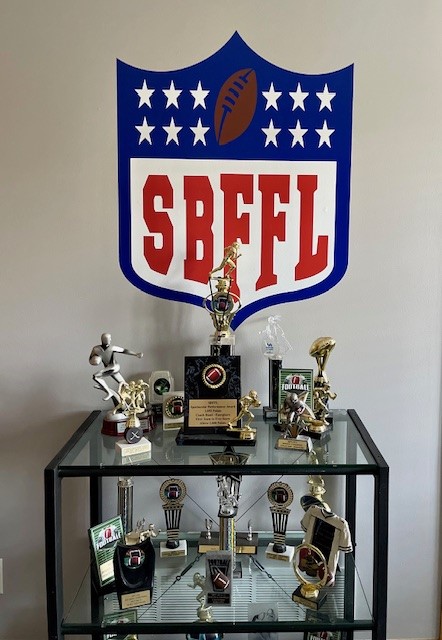
While Coach Walt does have six (6) wins, many of his championship victories were won by just a few points, i.e., a small margin of victory. Conversely, in 2020 and 2021, I dominated the league completely, from beginning to end, winning everything there was to win, and breaking or setting new records along the way. Division title, best regular season win-loss record, most cumulative points scored, first team to break the 2,000-point barrier, back-to-back Super Bowl titles, and a lifetime achievement award for the most dominating performance in league history … I was showered with trophy after trophy. No one has ever done as much, and I did it in back-to-back consecutive seasons! When you go to the local barbershop, bookstore, supermarket, or even a nail salon, people still talk about it.
First Down —> 🏈
I have been asked, “when did you first realize you would embark upon a successful career in fantasy football, and then reach the exalted level of commissioner?” Believe it or not, I can recall the exact moment. It was at a very young age, before I could talk, and even before I was out of the crib. It was my first moment of self-realization. Allow me to explain:
One day, in the middle of the afternoon, circa. 1963, after receiving hours of attention during playtime, I was delivered to my crib for an afternoon nap. Well, I was not ready for a nap, so I climbed over the top rail of the crib and dropped myself to the floor. When my parents discovered my escape, my father entered the room, and as he lifted me up, I found myself facing toward a large dresser and mirror, and for the first time ever, I saw my reflection and realized, “Hey, that’s me!“ This was my first moment of self-realization. I remember thinking, “Hello me!”
But that’s not all. Almost immediately, the next thought that entered my mind was, “OMG! Why am I dressed like that? Why am I dressed like the former British Prime Minister, Winston Churchill? This is not the 1950s. It’s the 1960s, Man!”
I was wearing khaki-colored corduroy pants, a button-down shirt, a dark-colored sweater vest, and a clip-on bow tie. I couldn’t believe it. Why couldn’t I be a hairy-chested, gold chain-wearing, no-tie hippie, in bell-bottom blue jeans? That’s what all the cool cats were wearing in the 1960s.
Anyway, when I saw myself for the first time, and saw what I was wearing, I knew I wouldn’t grow up to be a rock star. I wasn’t wearing the right outfit. I also knew I wouldn’t be a doctor (no scrubs), a lawyer (no briefcase), an engineer (no pocket protector), a gourmet chef (no apron), or an athlete (no brand name sneakers 👟). With a sweater vest on, and a clip-on bow tie, my destiny was sealed. I would be a commissioner … a commissioner of what, I did not know, but a commissioner nonetheless.
Yes, I did also become a lawyer 💼, but that’s just a side gig! My true value to society is as a commissioner. I must admit, however, that my training as a lawyer has enabled me to craft powerful, persuasive, and well-reasoned legal opinions to resolve fantasy football disputes.
Second Down —> 🏈
We need a break from football 🏈, so let’s talk about environmental law for a bit. The Rivers and Harbors Act, which I mentioned earlier, was the first national pollution control law, but it was not extensive in the measure of environmental protection it conveyed. Today’s environmental laws are much more comprehensive and technically sophisticated.
Here’s a more contemporary list, in chronological order (including citations) with a brief description of what each provision covers:
- National Environmental Policy Act, 42 U.S.C. 4321 (1969) – directs federal agencies to give proper consideration to potential environmental impacts that may result from major federal actions;
- Clean Air Act, 42 U.S.C. 7401 (1970) – regulates air emissions from stationary and mobile sources;
- Clean Water Act, 33 U.S.C. 1251 (1972) – regulates the discharge of pollutants into navigable waters and establishes water quality standards for surface waters;
- Endangered Species Act, 16 U.S.C. 1531 (1974) – offers protection to threatened and endangered species and their habitat;
- Safe Drinking Water Act, 42 U.S.C. 300f (1974) – regulates water systems that provide potable water for human consumption;
- Resource Conservation and Recovery Act, 42 U.S.C. 6901 (1976) – regulates generation, transportation, treatment, storage and disposal of hazardous waste and establishes a framework for management and disposal of non-hazardous waste;
- Comprehensive Environmental Response, Compensation and Liability Act, 42 U.S.C. 9601 (1980) – provides for the cleanup of abandoned hazardous waste sites and emergency response to spills and releases of hazardous substances into the environment.
I’m pretty familiar with all of these laws, since I’ve had to eat, sleep, and drink them since 1987. My favorite one is CERCLA (last on the list) because of the way it came about, and because of the cool nickname it was given: “Superfund!“
It all started in the late 1970s, in Niagara Falls, N.Y., when chemical contaminants were discovered seeping into people’s homes in a residential area known as Love Canal. The source of those contaminants was the Hooker Chemical Company, and my sociology professor at the State University of New York at Buffalo was not a big fan. She spent more than 50% of our class-time talking about Love Canal, and to this day, I still don’t know what Love Canal had to do with sociology. Anyway, Love Canal was the trigger that led to the passage of CERCLA. This law established a comprehensive process to clean up uncontrolled hazardous waste sites all over the country, and Love Canal was the first beneficiary.
You may be thinking that the passage of CERCLA made my sociology professor happy, but I did not perceive happiness in her words, just outrage. This is one of the reasons I excluded her from membership in our fantasy football league 12 years later. She still calls periodically to inquire about vacancies, but we just brush her off. The truth is, we don’t often have vacancies. We had one earlier this year, when Coach Stan of the Bone Crushers announced his retirement, but it was quickly filled. By the way, who retires from fantasy football? Is it so stressful that a person has to retire?
Third Down —> 🏈
Before we move on, let me comment on an ongoing dispute within our league. It involves the use of waivers.
You’re probably wondering, “what is a waiver?” Well, it’s a stupid name for a process that helps weaker teams in our league to improve. They do this by exercising a weekly option to obtain higher quality free agents before stronger teams get a chance.
Now, you may be asking, “why am I opposed?” I have three reasons: (1) it would force us to dispense with “special teams,” a beloved scoring category for thirty-two years; (2) it would force us to integrate elements of socialism into our league; and (3) it would increase the risk of evolutionary rejection by a future, non-human, dominant species.
Let me provide more context:
What can I say about special teams? We start every draft with special teams, and there’s a lot of scoring that occurs when special teams are on the field. I’m worried about making this change. This is really the strongest reason for my objection. I just love special teams!!
What about socialism? Well, as some of you know, I visited Paris, France in July to attend the 2024 Olympic Games, and to study the works of Karl Marx, Pierre Benoit, Léon Blum, and other famous socialists. Why study socialism? Because that’s what we’re doing to the SBFFL by adopting a waiver system. The great performers in our league have been judged to be too great, so to even the playing field, we are giving the weak performers a socialist boost up. I don’t think this is a good idea. This is a competition, and great performers should be rewarded. Yes, I did discuss this with many French citizens during my visit to Paris, and almost all of them recommended that we integrate socialism into our league, but after I reminded them the USA (a capitalist country) bailed them out in WWI and WW2, many of them rallied around my idea of dismissing the waiver system. What do you think? Do you agree with the people of France?
Interesting side note on France: Yes, the USA did bail them out in WWI and WWII, but to be fair, France provided arms, ammunition, supplies, troops and naval support to George Washington in our war for independence against Great Britain. Approximately 12,000 soldiers, 22,000 naval personnel, and 63 French warships joined our rebellion. In fact, this assistance (facilitated by the Treaty of Alliance and the Treaty of Amity and Commerce) was a key component in securing a surrender from British General Cornwallis at the Battle of Yorktown in 1781.
Anyway, let’s get back to waivers. When I first wrote on this topic, I was emotional because it felt like this waiver initiative was an attack against the SBFFL. That’s what was happening. A few underachievers want to gain an advantage because they can’t compete on a level playing field, so they introduce strategies designed to alter the very essence of our league. They don’t care about honor, integrity, continuity, or even evolution.
Yes, evolution!
In 10,000 years, when the Earth transitions into a Planet of the Apes, what will the apes think when they find what’s left of our league and resurrect it so they can play fantasy football? Only one of two things can happen: (1) They will think, “Ooo Ooo, Ahh Ahh … this fantasy football league is built upon a solid foundation, with an enduring structure and framework; or (2) they will examine it and say, “Ooo Ooo, Ahh Ahh … this fantasy football league has waivers. Let’s throw our monkey poo at it.”
Who wants his or her name to be associated with monkey poo? Yes, I see you, Coach Mark (Detroit Cats).
Fourth Down —-> 🏈
The SBFFL has been in existence for 32 years, and over the course of our 3+ decades, a lot has happened. Sit down and relax as I recall another great moment in SBFFL history:
Let’s go back in time, to the SBFFL’s 2004-05 season. It is the second week of the playoffs, and the Untouchables (managed by Coach Bob B.) are facing off against the Energizers (managed by myself, Coach Rami). Back then, a score above 90 was usually good enough to win the average game. But that wasn’t good enough for Coach Bob B. He was out to make a statement, and in doing so, he put together a formidable starting lineup, including QB Billy Volek (56 points), RB Larry Johnson (25 points), and the Carolina Panthers DEF (30 points). By the end of the day (Sunday), Coach Bob had produced a very impressive, and seemingly insurmountable, 150 points. WOW! That was a lot of points! In fact, by every historical measure, it looked like Coach Bob B. had the game wrapped up, and the win in his pocket.
But the weekend wasn’t over yet.
There was still one game left, the Monday night game, and a lot of players on the Energizers’ roster were playing in that game. In fact, the amount of scoring that took place in that one game alone was quite spectacular: QB Daunte Culpepper (45 points), RB Jerome Bettis (19 points), RB Domanick Davis (16 points), WR Drew Bennett (26 points), WR Eddie Kennison (20 points), and the San Diego Chargers DEF (20 points). It was amazing! The Energizers had achieved the impossible, defeating the Untouchables by two points in the final few minutes of the playoff weekend. The final score was 152 to 150! OUCH! When the outcome was revealed, ESPN quickly decreed that game to be the greatest comeback in fantasy football history.
Whenever I recall this game, I always think about the SBFFL ant song:
- 🎵 Once there was an SBFFL ant, thought he’d move an NFL football plant, everyone knows an ant, can’t, move a football plant, but he had high hopes, he had high hopes, he had high Monday Night Football pie, in the sky hopes, so anytime you’re feeling sad, instead of feeling bad, just remember that ant … ooops, there goes another NFL football plant. 🎶
By the way, Coach Bob B.’s efficiency rating in that game was 94.9%. He left only eight (8) potential points on the bench in selecting his starting lineup. That’s pretty impressive … but that impression fades quickly when you learn what my efficiency rating was: [DRUMROLL PLEASE] – The Energizers’ Coach Rami finished that game with an efficiency rating of 99.3%, leaving only one (1) potential point on the bench. Wow! That’s remarkable! Now you can be impressed!
First Down —> 🏈
Two critical environmental components that are needed to support a strong and enduring fantasy football league are clean air and water. You can’t compete in fantasy football without clean air and water. That’s why the federal Clean Air Act and Clean Water Act are both so critical to the fantasy football industry.
The Clean Air Act is a relatively complex law, but simple in the way it is organized. It started in 1963 with a focus on monitoring and research, i.e., to study the effects of air pollutants on human health and the environment, but it didn’t pack a punch until the new version was enacted in 1970. That’s when the program really started to roll. Suddenly, the 1963 obligations to “monitor and report” emissions were expanded to include “reduce” emissions (of criteria and hazardous air pollutants). The new law also gave the U.S. Environmental Protection Agency significant enforcement authority, and in 1977 and 1990, it was amended to include provisions focused on reducing acid rain and ozone layer depletion.
What’s the story with ozone? Well, when it comes to fantasy football, nothing can have a greater negative impact on performance than exposure to harmful radiation from the sun. That’s why depletion of the ozone layer is such an important concern in the fantasy football industry. But now, we have some good news, and less reason to worry.
First, what is ozone? Well, ozone is a gas made up of three oxygen atoms. The chemical symbol is O3, and it exists in the upper and lower atmosphere. In the upper atmosphere (i.e., stratosphere), it protects the Earth from the harmful ultraviolet radiation of the sun. In the lower atmosphere (i.e., troposphere), where it is commonly referred to as smog, it can cause minor to severe respiratory illness.
Our focus right now is on O3 in the upper atmosphere.
The bad news is that for many decades, the ozone layer was being depleted by the release of chlorofluorocarbons (CFCs) and other ozone depleting substances into the upper atmosphere. Specifically, a chemical reaction in the stratosphere, triggered by the ultraviolet rays of the sun, caused the chlorine atoms in CFCs and other ozone depleting substances to react with O3. That chemical reaction caused one of the oxides in O3 to separate from the compound, leaving behind O2 and chlorine monoxide (chemical symbol “ClO”).
Then in 1985, three scientists discovered a hole in the ozone layer forming over Antarctica, and that hole was getting bigger. That meant one thing for the Earth and fantasy football enthusiasts. First, we’d have to stop using CFCs, and second, until further notice, no fantasy football in Antarctica! That’s one entire continent where fantasy football is banned.
Now here’s the good news. In 1987, a multinational environmental agreement known as the Montreal Protocol was entered into by the majority of the world’s industrialized nations. Under the terms of that agreement, each nation committed to the implementation of legal measures to ban or otherwise limit the use of CFCs and other ozone depleting substances. The United States did that in 1990, when it added Title VI to the Clean Air Act.
I am now happy to report the Montreal Protocol is working. The ozone layer is repairing itself, and if the current rate of progress continues, the ozone hole over the Antarctic will be fully restored by 2066. Personally, I look forward to the day when fantasy football can resume on the Antarctic continent. In fact, I’ve already booked a flight to attend the ribbon-cutting ceremony.
Now for a commercial break:
- Hey fantasy football managers, do you need an extra boost to stay mentally focused for fantasy football weekend? I know I do. That’s why I start each day with a deep inhale of my new product, “Fantasy Football MaxO2 (oxygen),” and a super big gulp of “Fantasy Football MaxH20 (water).” The elements in both of these products are super-charged to enhance strategic awareness and maximize fantasy football performance. Don’t wait! Try MaxO2 and MaxH2O today!
Second Down —> 🏈
“Chicanery” is the term we use to describe efforts that undermine the structure, framework, and integrity of the league. There have been many attempts in the past, but we’ve always been able to fight them off.
In this context, you can think of myself and Co-commissioner Walt, as fantasy football jedi knights. We use the fantasy football force to protect the SBFFL republic. At the same time, there are elements within the league that use the dark side of the fantasy football force to undermine the republic, to satisfy their own greedy objectives.
What is the fantasy football force? It is an energy field that exists within all living things involved in fantasy football. The will of the fantasy football force is communicated to us by a microscopic life form, known as a midi-chlorian, which occupies our living cells; and if the concentration of midi-chlorians in our bodies is high enough, we become force sensitive and have access to special fantasy football powers.
Some believe Coach Walt’s six (6) Superbowl championships, and my history-making performance in the 2020 and 2021 seasons, combined with five (5) Superbowl championships, may be attributable to high concentrations of midi-chlorians in our respective bloodstreams.
Coach Mark (Detroit Cats) also has five (5) Superbowl championships, but he recently changed his team’s name from Chargers to Detroit Cats to Motor City Kittens. This is an early sign that Coach Mark may be embarking upon a journey to the fantasy football dark side, but we can’t be sure.
However, time will tell because when it comes to chicanery, “Always two there are. A master and an apprentice. No more, no less.“
Third Down —> 🏈
Now, let’s talk about sustainability, and the most eco-friendly stadiums in the NFL.

To begin, I’m sad to say that Highmark Stadium (Buffalo) is tied for last place with six other stadiums:
- Highmark Stadium (Buffalo)
- Paul Brown Stadium (Cincinnati)
- Empower Field at Mile High (Denver)
- TIAA Bank Field (Jacksonville)
- Allegiant Stadium (Las Vegas)
- SoFI Stadium (Los Angeles)
- Nissan Stadium (Tennessee)
In Buffalo’s defense, Highmark was built in 1973, over 50 years ago. That’s pretty old. The good news is that construction of a new stadium is currently underway, with an expected completion date in 2026.
On the other side of the sustainability spectrum, five (5) stadiums are tied for first place, and occupy the top tier of sustainable NFL football venues:
- Levi’s Stadium (San Francisco)
- Lincoln Financial Field (Philadelphia)
- Soldier Field (Chicago)
- M&T Bank Stadium (Baltimore)
- Mercedes Benz Stadium (Atlanta)
These venues utilize a number of strategies to become eco-friendly. Philadelphia’s LINC, for example, has the largest solar panel array in the NFL and several micro wind-turbines that provide a significant amount of energy to support stadium operations. The LINC also has a comprehensive recycling program which doesn’t just focus on everyday trash. It collects used fryer oil from the stadium’s concession stands and converts it into biodiesel to provide fuel for the stadium’s maintenance vehicles and other equipment. Now that’s thinking outside the sustainability box!
It doesn’t surprise me to see some of the older stadiums (like Buffalo’s) in the bottom tier of the sustainability list, but SoFI (San Francisco) and Allegiant (Las Vegas) are relatively new. What happened?
I’m also surprised to see Soldier Field (Chicago) in the top-tier because it is the oldest stadium in the league. But being old hasn’t stopped stadium management from implementing a recycling program, using composting, procuring and serving locally-grown foods, or donating unused foods to homeless shelters. They’ve also replaced conventional lighting with LEDs and installed free charging stations for electric cars. Wow! Now, that’s my kind of town; my kind of people too … 🎶
Interesting side note regarding Buffalo’s Highmark Stadium: It was originally named Rich Stadium (1973-1997), Ralph Wilson Stadium (1998-2015), New Era Field (2016-2019), Bills Stadium (2020), and now Highmark Stadium (2021-Present).
Another side note: Ralph Wilson was the original owner of the Buffalo Bills, and one of the architects of the merger between the American Football League (AFL) and the National Football League (NFL). His original investment in 1959 was $25,000. After he passed away in 2014, his family sold the team for $1.4 billion.

One more side note: The Southside High School Band played on the field at Buffalo’s Rich Stadium in the 1975 season opener. I played the clarinet, the most charismatic of musical instruments, selected for me as an extension of my charismatic personality. Meanwhile, Coach Walt (Weekend Warriors) and Coach Bob O. (Blasters) were both on percussion. They played like chimpanzees equipped with kitchen utensils, banging on pots and pans. I had to play extra loud that day to camouflage the off-rhythm performance of the percussion section.
Fourth Down —> 🏈
I just realized that I haven’t formally introduced the members of the Santa Barbara Fantasy Football League. Well, here they are (in no particular order):
- Energizers – Coach Rami 🏈🏈🏈🏈🏈
- Weekend Warriors – Coach Walt 🏈🏈🏈🏈🏈🏈
- Blasters – Coach Bob O. 🏈🏈
- Untouchables – Coach Bob B. 🏈🏈
- Green Machine – Coach Tom 🏈🏈
- Detroit Cats – Coach Mark 🏈🏈🏈🏈🏈
- Revolution – Coach Travis
- Supermen – Coaches AL and Rami Jr.
- Art Linkletter’s Book Club – Coach Kyle
- Claw Masters – Coach John 🏈🏈
- Monkey Poo – Coach Taylor
- Rented Mules – Coach Larry 🏈🏈
The footballs represent the number of Superbowl championships won by each team. You will notice that four teams have no footballs at all. They are all managed by members of the SBFFL’s next generation. What’s wrong with them?
To be fair, Coach Taylor is new, stepping in to replace retired (or maybe “tired”) Coach Stan and his Bone Crushers 🏈🏈.
You may have also noticed that after 32 years of competition, exactly one-half (1/2) of all Superbowl championships have been secured by three dominant teams: the Energizers, Weekend Warriors, and Detroit Cats. That’s not luck 🍀. That’s football knowledge, skill, and know-how!
First Down —> 🏈
We’ve talked about the NFL’s football stadiums 🏟️, specifically, those that are eco-friendly, but did you know that some of them were built over contaminated land? Take Mile High Stadium in Denver, for example, and the old Meadowlands Stadium in New Jersey. They were built over the top of landfills. The bad news for these landfill locations is that they carry the stigma of being constructed over a landfill, and if appropriate protections are not implemented, stadium users may suffer health impacts.
To avoid adverse health impacts, developers typically implement measures to ensure the landfill is carefully capped, so that the contaminants and their associated vapors are not allowed to escape to the surface. Other times, the contaminated soil and other debris are completely excavated, and transported to a licensed facility for treatment and/or disposal.
If the contamination problem is particularly complex, or the risk to human health or the environment is significant, then there’s a comprehensive process that comes into play under CERCLA (Superfund Law). Here are the various steps, with relevant commentary:
- Preliminary Assessment – Is there something there? What was this site used for in the past? Let’s do some research. 🧐
- Site Inspection – Hmmm, there might be something there. Let’s go take a look. 👀
- Remedial Investigation – Houston, we have a problem! We found something. Let’s collect some samples and send them to a lab. 🧪
- Feasibility Study – What remedial options do we have? Let’s evaluate them and choose one.
- Record of Decision – We have a remedial action plan, Stan! No need to be coy, Roy! Let’s tell the public.
- Remedial Design – Let’s put pen to paper and develop the blueprints for this remedy.
- Remedial Action – Let’s get to work! Can someone pick up a pizza? 🍕
- Long-term Monitoring and Maintenance – Let’s keep an eye on this site. We have to make sure the remedy works. Failure is not an option!
Second Down —> 🏈
Earlier in my blog, I mentioned that the Andromeda Galaxy will merge into our own Milky Way Galaxy in about 4.5 billion years. This is good news because, according to NASA, although our Sun may be flung into another region of the galaxy, the Earth and the rest of our solar system will not be destroyed. This hypothesis is backed up by data from the Hubble Space Telescope.
Now here’s the bad news! Approximately 500,000 years after the Andromeda “meet and greet,” our Sun ☀️ will exhaust its hydrogen supply and begin its slow transformation into a dying red giant. When this happens, the Sun’s core will shrink and the outer layers will expand, reaching the orbit of Mars. This is bad news for the inner planets, including the Earth 🌎, and bad news for fantasy football as we know it.
What can we do?
Move like the Rams! Move like the Raiders! Move like one of the other NFL teams that has chosen to relocate to ensure its survival. In fact, it was not uncommon during football’s early years (particularly during the Great Depression) for small-market teams to relocate to large cities to ensure their financial survival. Within the NFL, a handful of teams have relocated (some more than once) in response to factors such as financial stability, market size, or stadium deals.
Here is the list of NFL teams that have relocated:
- 1946 – Cleveland Browns to Los Angeles
- 1960 – Dallas Texans to Kansas City
- 1982 – Oakland Raiders to Los Angeles
- 1984 – Baltimore Colts to Indianapolis
- 1995 – Los Angeles Rams to St. Louis
- 1995 – Los Angeles Raiders back to Oakland
- 2016 – St. Louis Rams back to Los Angeles
- 2017 – San Diego Chargers to Los Angeles
- 2020 – Oakland Raiders to Las Vegas
Anyway, getting back to our cosmic threat, which is still 9 billion years out, NASA has located over 5,000 exoplanets, and a fraction of them appear to be “Earth-like”. 🌏 NASA uses three criteria to define the parameters of “Earth-like:” (1) a rocky planet; (2) located within the host-star’s habitable zone (suitable for humans); and (3) where conditions allow liquid water 💧 to exist. If we’re lucky, we may also find a few with fresh natural grass versus astro-turf inside their extraterrestrial stadiums.🏟️
So, when the time comes, move everything and everyone, to a new star system, where fantasy football can survive and thrive!
Third Down —> 🏈
Let’s talk about risk.
Environmental Law is all about reducing risk. Specifically, it’s about reducing the risk to human health and the environment. The objective of the Clean Air Act is to reduce the contaminants emitted into the air; the objective of the Clean Water Act is to reduce the pollutants discharged into water; and the objective of RCRA is to manage and track waste materials from cradle to grave (to make sure they’re disposed of properly).
In fantasy football, there is risk, but it’s a different kind of risk. It’s the risk of compromising the authenticity and integrity of the game. We call this type of risk: “Chicanery.” It is the greatest risk to fantasy football, and the greatest risk to the SBFFL.
What exactly is chicanery? It manifests itself in many ways (e.g., false political promises), but within the context of fantasy football🏈, it is the use of trickery to achieve a competitive advantage. Some common synonyms of chicanery include: deceit, deception, duplicity, and dishonesty (a lot of words that start with the letter “D”).
But there’s one “D” word that is not included within this list. It is “DEFENSE,” and that’s where the SBFFL shines. The league has committed hundreds of thousands of dollars to fund research and development of advanced anti-chicanery defense (AACD) capabilities. The SBFFL has also deployed a highly-trained AACD strike force that can be dispatched at a moment’s notice, 24 hours a day, 7 days a week (even during the off-season).
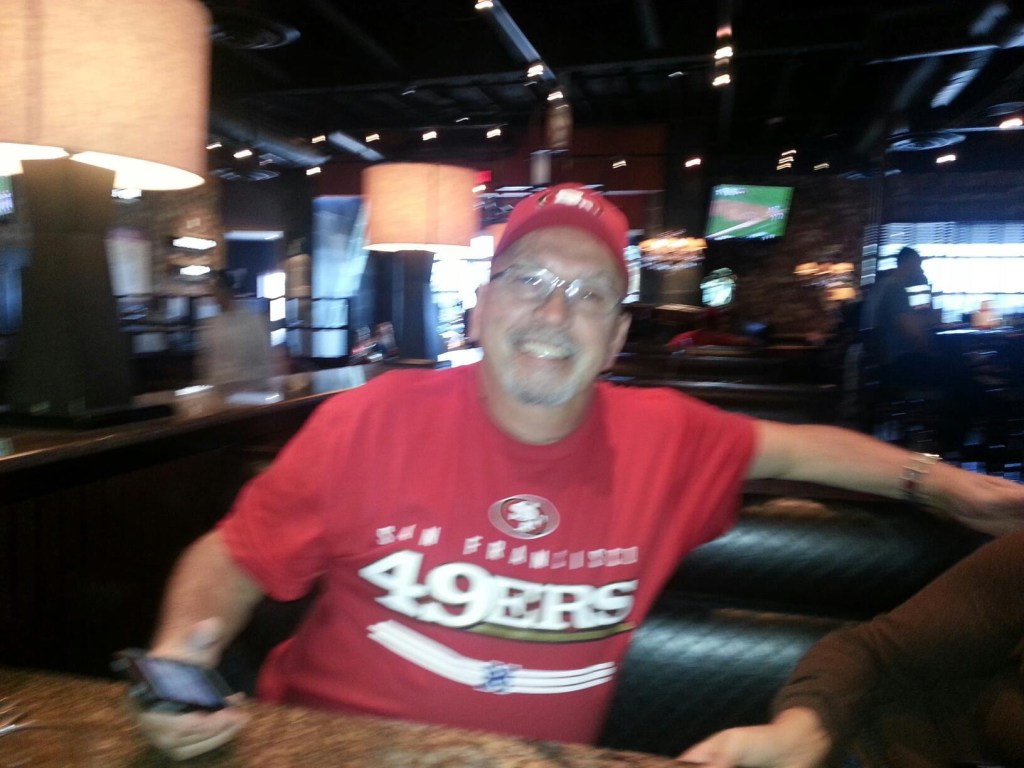
Within the SBFFL, the master of chicanery has always been Coach Stan of the Bone Crushers. Here he is, caught red-handed (and red-shirted) wearing a San Francisco 49ers shirt, despite claiming to be a member of the Buffalo Bills Mafia. I’ll tell you about some of his chicanery later, but for now, what does the Bills Mafia think of this chicanerous display? 🤔
Fourth Down —> 🏈
Now that we’ve brought up chicanery, let’s talk about losers. In the distant past (circa. 1990s), we treated losers like they were losers, completely independent and distinguishable from their successful counterparts, the winners. In fact, I was often quoted by the media saying, “Show me a good loser, and I’ll show you a loser.”
But later, we came to realize that without losers, there could be no winners, and if the losers suddenly went on strike or just disappeared, the world of sports would immediately collapse, and so would fantasy football. So, we decided to embrace the loser as an important component of every winning team. Also, at the suggestion of Coach John (Claw Masters), we instituted a special form of recognition, known as the Toilet Bowl Award, to acknowledge the important contribution losers make in helping to create a winning team.
Here are the last ten (10) Toilet Bowl Award winners in chronological order:
- 2014 – Chargers (Coach Mark)
- 2015 – Supermen (Coach AL)
- 2016 – Claw Masters (Coach John)
- 2017 – Bone Crushers (Coach Stan)
- 2018 – Blasters (Coach Bob O.)
- 2019 – Blasters (Coach Bob O.)
- 2020 – Chargers (Coach Mark)
- 2021 – Supermen (Coaches AL & Rami Jr.)
- 2022 – Bone Crushers (Coach Stan)
- 2023 – Energizers (Coach Rami Sr.)

Two-Time Winner of the Toilet Bowl Award
You may have noticed that four (4) coaches on this list are two-time recipients of the Toilet Bowl award. They have worked extra hard at losing to help others win, and for that reason, they deserve special recognition.
Why is my name on the list? Well, after winning back-to-back Superbowl championships in the 2020 and 2021 seasons, along with countless other awards, including the SBFFL’s first-ever, “Spectacular Performance Award,” it was time for the Universe to rebalance. This happens when a winner wins everything there is to win, in every possible statistical category, and does it again the following season, BACK-TO-BACK, JACK. It was too much! Neither society, nor the cosmos could handle it … so, the Universe began a two-year rebalancing process.
I think the Universe is now focused on Coach Tom (Green Machine). He had a spectacular regular season in 2023, but couldn’t close the deal at Superbowl time! I think the Universe noticed his 12-2-1 regular season record, and then said, “WHOA, Coach Tom! The waters are choppy up here. Let’s steady the ship, Mate!”
OUCH! That had to hurt! 😢 So close, but yet so far.
Anyway, yes, this is how the Universe works. It always seeks balance. That’s why I never worried about losing one or two games along the way to becoming the greatest coach in the history of fantasy football!
First Down —> 🏈
We’ve talked enough about fantasy football losers, so let’s switch gears and talk about environmental losers.
I hate to say this, but I think trees are the biggest losers in the environmental arena, mostly because humans have decimated them.
Twelve thousand years ago, there were 6 trillion trees on the planet (that’s “trillion” with a “T”). Now there are only 3.04 trillion, and we continue to lose 10 billion trees per year, mostly due to logging, urbanization, and agriculture.
Trees are important because they have a symbiotic relationship with humans. They absorb carbon dioxide from the atmosphere and replace it with oxygen (photosynthesis), while humans do the “opposite.” It’s a mutually beneficial biologic relationship. That’s what “symbiosis” means. In fact, on average, a single tree can produce enough oxygen on a daily basis to support four (4) people.
By the way, I refer to them as trees, but in biological terms, trees belong to the Plantae kingdom in the Tracheophyta (vascular plant) division. They can be further subdivided by class, order, family, genus and species. For example, the common oak tree can be classified as follows:
- Kingdom: Plantae
- Division: Tracheophyta
- Class: Magnoliopsida
- Order: Fagales
- Family: Fagaceae
- Genus: Quercus
- Species: Quercus robur
Today, we have a ratio of about 400 trees per human. That’s more than enough to produce the oxygen we need, but perhaps not enough to absorb all of the extra carbon dioxide we humans produce (a potentially significant factor to be considered in the climate-change debate).
This is where our existing framework of environmental laws fall short. We need a global initiative that protects the tree kingdom as a whole, not just a particular family, genus, or species of trees.
What can we do? Well, we can’t enact our own resolution or negotiate an international treaty. We’re not the United Nations. But we are the Santa Barbara Fantasy Football League (SBFFL); and as members of said league, we can work together with the United Nations to recognize, acknowledge, and embrace trees for the symbiotic contribution they make to the fantasy football world. Moreover, beginning in the 2024-25 season, the SBFFL will commission an annual “Friend of the Trees” award, to be presented to the coach who has gone the extra mile to benefit our friends, the trees.
FYI – Here are the ten (10) countries with the world’s largest forests, ranked by number of trees (in billions):
- Russia (641)
- Canada (318)
- Brazil (302)
- USA (228)
- China (140)
- D.R. Congo (101)
- Indonesia (81)
- Australia (77)
- Bolivia (59)
- Mexico (57)
Notice there are no European countries (except Russia) in the top ten list. That’s because Europe eliminated 95% of its forest areas to further agriculture, urbanization, and industrialization beginning in the mid-1760s. Yes, I know a portion of Russia, west of the Ural Mountains, is located in Europe, but the majority of its trees are not.
How did Russia come to control so much territory, and so many trees (double the number of second place Canada)? Sit back and relax as I explain how a jealous Ivan the Terrible, and a mini-ice-age in Europe, led to one of the biggest contiguous land grabs in modern day history.
Interesting side note: In 2008, my family purchased a home in Omaha, Nebraska. At the time of purchase, the land around this home was completely barren of trees and other vegetation. Twelve years later, there were ten (10) full-size trees located on the property, along with numerous other plants and shrubbery. Does this make me a contender for the 2024-25 Friend of the Trees award? No, but … YOU’RE WELCOME FOR THE OXYGEN!
Second Down —> 🏈
I hate to be critical of our nation’s capital, but I cannot ignore this. I think most of us know that Washington D.C. was named after our founding father and first president, George Washington (no middle initial). During the Revolutionary War, he held the rank of General and Commander in Chief of the Continental Army. Subsequently, after his death, he was promoted to General of the Armies of the United States, making him the highest-ranking military officer in the history of the United States.
This rank encompasses all branches of the military, including the Navy and Air Force. It was crafted this way to ensure Washington would maintain supremacy over all military personnel – past, present, and future – across all branches of the military.
So, he’s the man! No one can argue with that. But come on! He was a general. He never held the title of “commander,” which by the way, is a lower ranking position within the Navy. The Navy equivalent of a general is an admiral, and below admiral comes captain, and then commander.
So why did the former Washington Redskins change the team’s name to Washington Commanders? Why not the Washington Generals? I know, I know … some of you will say he was the “Commander-in-Chief,” but he wasn’t referred to that way. He was a general! When people encountered him in the DC Metro, or at the Pentagon City Mall, they would greet him by saying, “Good morning, General Washington, or “Howdy GW!” There was no reference to a commander-in-chief.
So why did they choose the Commanders? It just doesn’t add up!
___________________________________________________________________________
Coming Soon
ENVIRONMENTAL LAW – THE MOVIE!!
Starring Rami Hanash
as
Environmental Lawyer, “Granite Rock” 🪨
and
Snoop Dogg
as
“Reggie,” the Paralegal
 Rami Hanash